

Set Apart Faith in a World That Tries to Shrink It
There’s a kind of faith that doesn’t make sense on paper.
Faith that keeps believing in the middle of adversity.
Faith that refuses to die when circumstances say it should. Faith that trusts God’s voice even when support, affirmation, or clarity feels scarce. Scripture tells us this kind of faith is not something we manufacture. It is a gift.
The apostle Paul reminds us that faith itself is given by God (Ephesians 2:8–9), and that God distributes different measures of faith according to His purpose (Romans 12:3). And this is where grace becomes practical. Grace does not mean God lowers His standard or ignores reality.
It means God meets us within our limitations and supplies what we cannot produce on our own. Grace is God saying,
“I know what you lack — and I will provide it.”
If faith were dependent on our consistency, confidence, or clarity, it would collapse under pressure. But because faith is a gift of grace, it can exist even when we feel unsure, exhausted, or afraid. That’s why believing when life is hard isn’t proof of spiritual strength. It’s evidence of God’s sustaining mercy at work in us. This kind of faith invites us beyond our short-sightedness—beyond what feels statistically possible or logically safe—and into trust that God can open our hearts and minds to a reality not limited by space or time.
A place where the impossible becomes possible, feeble hopes are redefined as favor, and dreams that feel “one in a million” are held by a God who lacks nothing—but this faith often comes with a cost.
It can feel lonely. Walking with conviction when others don’t understand. Feeling disoriented by the pace of progress compared to the process God has you on. Trying to interpret swirling, at at times unnamed emotions without letting them distort truth. And when faith is not actively grounded,
the mind does not remain neutral. It becomes vulnerable.
Without anchoring ourselves in grace and truth, our thoughts can quickly become a playground for the enemy — a place where what God is cultivating inside us, through us, and for His purposes is quietly attacked before it ever reaches maturity.
The Enemy’s Strategy Hasn’t Changed
The enemy doesn’t need new tactics—only familiar ones. From the beginning, one of his most consistent strategies has been to undermine trust in what God has already spoken. In the garden, the serpent didn’t outright deny God —he questioned Him. “Did God really say…?” (Genesis 3.) God had already provided everything Adam and Eve needed—intimacy, provision, purpose, identity. But once doubt took root, it created distance from truth—
and eventually, distance from intimacy with God. That same pattern still exists today.
How often does God place an idea, a vision, or a desire for change in our hearts—for our lives, our workplaces, our relationships, our futures and so on?And how quickly can doubt follow the moment of inception. What began with joy, hope, and anticipation can be stripped of life by questions like:
Who do you think you are? What if this doesn’t work? What if you misunderstood God?
There are many tactics the enemy uses—fear, distraction, comparison, discouragement, pride—but doubt remains one of his most effective tools, especially in the early stages. Because seeds are most vulnerable before they take root. Sometimes obedience looks less like public action or sharing of a premature idea, and more like quietly protecting what God has given you until it can be cultivated in health, order, and truth. First with the Lord. Then, in time, before others.
Jesus speaks directly to this reality in the parable of the sower (Matthew 13):
• Some seeds are stolen quickly
• Some grow shallow roots and wither under pressure
• Some are choked by cares, distractions, and fear
• Others fall on good soil and bear lasting fruit
The difference isn’t the seed. It’s the soil. God’s Word is powerful—but it grows best in hearts that are guarded, tended, and rooted in truth.
Dreamers, Delay, and Redemption
I’ve had to grieve this truth personally.
Like Joseph, I was a dreamer from a young age (Genesis 37). And like Joseph, those dreams were not only delayed —they were challenged by dream killers.
Some were close to me: family and friends who didn’t understand, dismissed what God was stirring, or spoke from fear instead of faith. Others were part of my environment: peers who bullied, authority figures who abused power, and systems that wounded instead of protected.
Over time, those experiences didn’t just delay dreams—they buried them beneath survival, responsibility, and the quiet endurance of adulthood. And yet, beneath it all, God’s desire never changed. God does not merely want us productive or obedient. He wants us healed and whole. This is His design.
But healing is rarely instant. It is often a process that requires time, consistent effort, and deep patience. It can feel like progress one season and regression the next— a push and pull between hope and weariness, clarity and confusion. Becoming is not an overnight transformation.
It is a slow, sacred work where God tends what has been wounded, strengthens what has grown weary, and restores what has been buried—without rushing the process.
Despite these circumstances, here again, grace met me. Grace does not mean God forces His plan into fruition regardless of our condition.
It means God remains faithful while inviting us to steward what He has given. God is sovereign—but He is also deeply relational. His purposes are secure, yet our participation matters.
Not because He needs us—but because He desires us. Your yes—no matter how small, hesitant, or trembling—matters to God. Every step of obedience creates space for healing. Every return to alignment with Christ opens the door for restoration. Every surrendered yes becomes an act of trust where grace continues its work.
Scripture shows us this again and again.
Moses resisted his calling.
Jonah ran from his.
David stumbled deeply.
Peter denied Jesus.
And still — God redeemed, restored, and used them mightily.
This doesn’t excuse disobedience. But it does reveal grace. God’s plan is not fragile — but our hearts must remain responsive. When we return, repent, and realign, God redeems what was mishandled, delayed, or wounded.
And the longing we carry for meaning, purpose, and restoration? It is not random.
Scripture tells us that “all exists through Him and for His purpose! He existed before anything was made, and now everything finds completion in Him” (Colossians 1:16–17, TPT).
That means your life is not accidental. Your wiring is not a mistake. Your desire for purpose is not self-created. You were designed with intention—
formed through Christ and for His purpose. And even when life feels fragmented or unfinished, He is still the One in whom everything finds completion.
This longing we feel—for healing, wholeness, and alignment—is not something to suppress or shame. It is the soul remembering who it came from and what it was created for. This is not poetic sentiment. It is divine design.
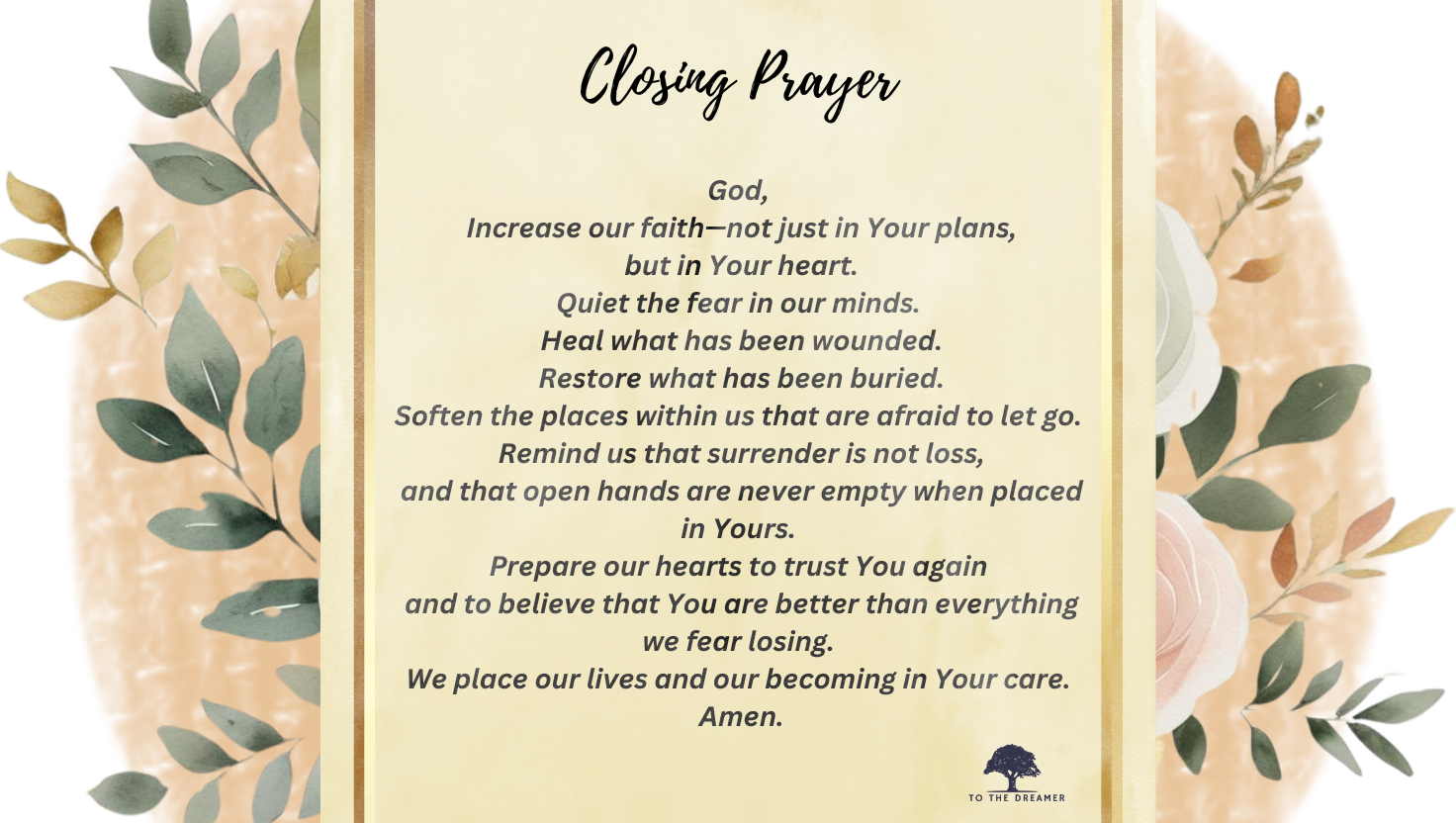
As we talk about faith, healing, and guarding what God has planted within us, it’s important to name something honestly—surrender is often where faith feels most costly.
It can stir fear, resistance, and grief—especially when surrender feels like losing the very thing we’ve been praying for, hoping for, or holding onto for survival.
For those who want to go deeper into this tension between faith, fear, and trust, this short teaching by Jackie Hill Perry offers language for what many of us feel but struggle to articulate. It reframes surrender not as loss, but as an invitation to believe—at the deepest level—that God is better than anything we’re being asked to release.